Surgical methods in rhinoplasty.
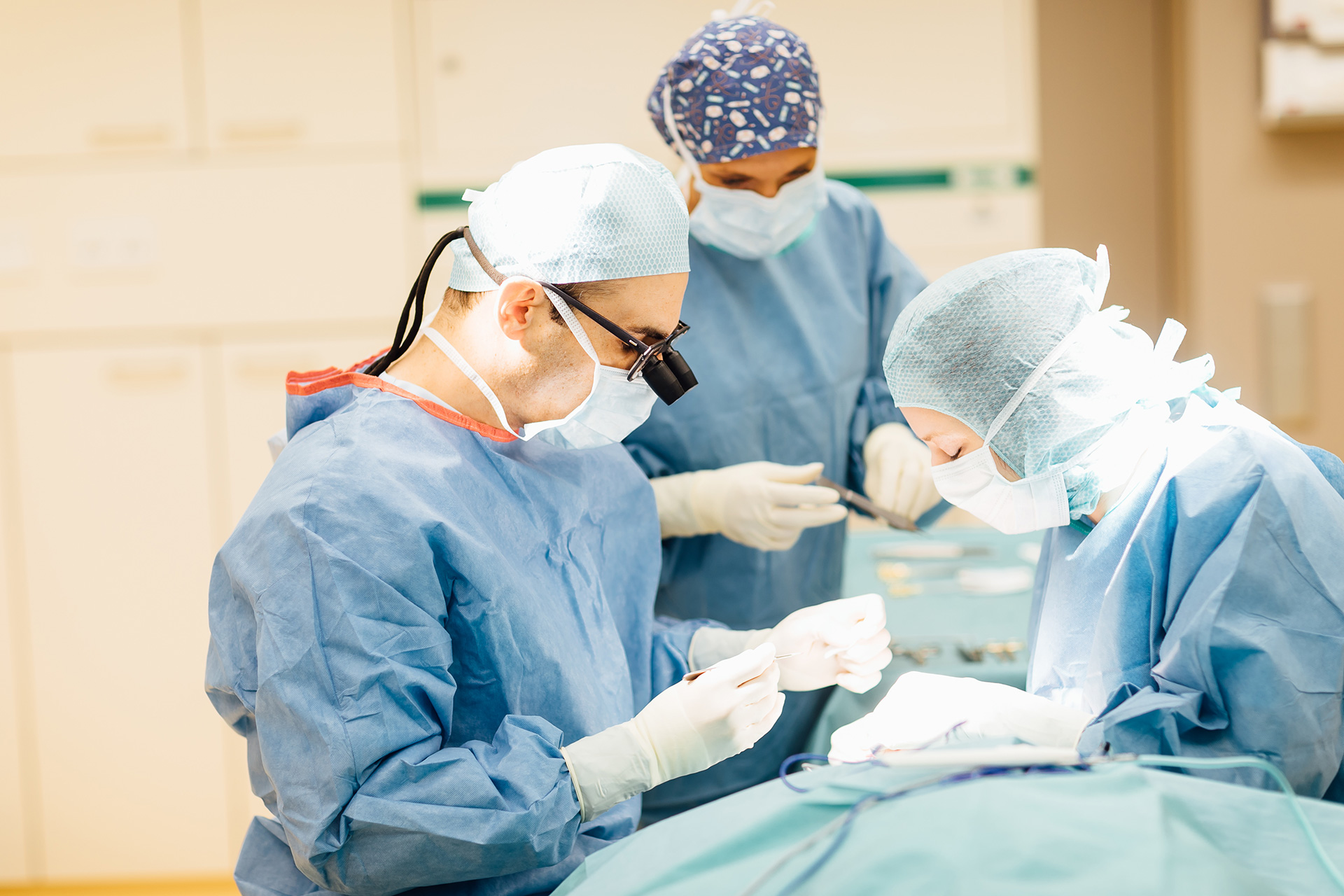
There is no single method for all noses — and that is exactly the point. Nasal surgery knows a whole range of techniques, from closed and open surgery through reducing and augmenting procedures to stabilisation with the body's own cartilage. At the Kuzbari Centre we have mastered the entire spectrum — and choose for each nose individually the method that leads to the best possible result.
The methods at a glance
| Approaches | Open and closed — depending on the findings |
|---|---|
| Techniques | Dorsal preservation, hybrid and structural techniques |
| Nasal tip | Stabilised with cartilage support the patient’s own cartilage, usually from the nasal septum |
| Duration of surgery | 1 – 4 hours |
| Anaesthesia | General anaesthesia |
| Stay | 1 night as an inpatient |
| Planning | Vectra 3D simulation at the initial consultation |
| Final result | 6 – 12 months |
Not one standard procedure — the best method for the situation at hand.
If every nose were operated on according to the same scheme, a great deal could be simplified — but that would not serve the best possible result. Because every nose is different: in its bony and cartilaginous structure, in the nature of the skin, in form and function and in the patient's wishes.
That is why we do not commit ourselves to one technique in advance. Our experienced team of surgeons has mastered every procedure in modern nasal surgery and decides for each operation individually which method — or which combination of methods — will most reliably bring you closer to your goal. That way the choice of method always stays what it should be: optimal for you.
Open or closed nose surgery?
Univ. Doz. Dr Rafic Kuzbari explains the differences between the two fundamental surgical techniques and their respective advantages and disadvantages.
The methods at a glance
An overview of the most important techniques in nasal surgery — which of them is used in your case we decide together and individually.
-
The closed technique
The whole procedure is carried out from the inside, through access points in the nose — with no visible external scars. Well established for defined, plannable corrections.
-
The open technique
Through a fine incision on the columella the surgeon gains maximum visibility — an advantage with complex starting points and corrections after previous surgery.
-
Reduction
An excess of structure — a hump or surplus tissue, for example — is removed precisely, to refine the line and the proportions.
-
Augmentation & stabilisation
Where structure is missing it is added — preferably with the body's own cartilage, which grows in and makes a natural, stable result possible.
-
Functional & aesthetic
Shape and breathing can be addressed in a single procedure — one anaesthetic, one operation, one healing phase.
-
Primary & secondary
Both first operations and demanding corrections after previous surgery are part of our focus.
The nose-bridge-preserving technique — dorsal preservation.
We work a great deal with the modern nose-bridge-preserving technique, known as dorsal preservation, and with hybrid techniques — not exclusively with traditional structural septorhinoplasty. The natural nose bridge is preserved instead of being removed and rebuilt.
To understand what this means, it helps to look at what a hump actually is. The nose bridge consists of a bony and a cartilaginous part, which meet over the nasal septum like a roof. In the classical, structural approach this roof is taken down at its highest point. This creates an open surface which then has to be closed and rebuilt — the line of the nose bridge is thereafter a reconstructed line.
With the nose-bridge-preserving technique this roof remains untouched. The height is not reduced at the bridge itself but lower down: a precisely measured piece of material is removed from the nasal septum and, depending on the variant, from the area beneath the nasal root. The entire nose bridge is thereby lowered as a unit and retains the surface it grew with. The line you see afterwards is your own — simply set lower.
This has three advantages. The result looks particularly natural. It is stable in the long term. And the risk of later irregularities on the nose bridge is reduced — which counts above all with thin skin, because there even the smallest edge becomes visible. Certain deviations also recur less often.
And one point of context that matters to us: dorsal preservation is not generally superior. For many findings it is the gentler choice, but there are starting situations in which a structural reconstruction is the better solution — for instance when the nasal septum is severely deformed, when material is missing after previous operations, or when the nose bridge is to be raised rather than lowered. That is precisely why we do not commit ourselves to one technique but choose it according to the findings. In between lie the hybrid techniques. They concern the nasal bridge alone: part of the bridge is preserved while other structures are modified in a targeted way. That keeps the advantages of dorsal preservation while widening the range of cases it can be used for.
Removing or preserving the nose bridge
Both principles are part of our repertoire and both have their place. This comparison shows what distinguishes them technically — the decision is always made on the individual findings.
| Aspect | Structural septorhinoplasty Removing and rebuilding the nose bridge | Dorsal preservation Preserving and lowering the nose bridge |
|---|---|---|
| Line of the nose bridge | Is removed and then rebuilt | Remains intact as a naturally grown unit and is lowered |
| Where the height is reduced | At the nose bridge itself | Lower down, at the nasal septum and beneath the nasal root |
| Effect with thin skin | Transitions have to be padded carefully so that no edge shows through | Lower risk of visible irregularities, because no surface is joined anew |
| Long-term stability | Good, provided the framework is consistently rebuilt | High, because the supporting structure is not interrupted |
| Deviations | Straightening by means of reconstruction and supporting elements | Certain deviations recur less often |
| Particularly suitable when | The nasal septum is severely deformed, material is missing or the bridge is to be raised | A hump is to be lowered, the skin is thin and the line of the bridge is worth preserving |
| Can be combined | Yes — often with cartilage-supported stabilisation of the tip | Yes — as a hybrid technique: part of the nasal bridge is preserved, other structures are modified in a targeted way |
Which of the two ways is the right one in your case is something we clarify at the initial consultation — on the basis of your examination and the 3D simulation, not from a catalogue.
Arrange an initial consultationWhy the inconspicuous nose is the greater art
A nose operation is always a radical change — the art lies in achieving a restrained, inconspicuous result with it. Dr Christoph Grill explains this contradiction and why small changes of all things are often the most difficult.

Stabilising it with cartilage support — why this is decisive over the years.
We stabilise the nasal tip with modern cartilage-supported techniques. This considerably reduces the risk of the tip dropping again over the years.
The background: the tip is carried exclusively by cartilage — by two paired alar cartilages that brace against each other, and by the front edge of the nasal septum, which holds it from below. If volume is taken away from this construction without replacing the mechanics, the tip loses its support. It can then migrate downwards over the years, the nose looks longer and the profile becomes curved again. The result that was right after one year is no longer right after ten.
Cartilage-supported means: we do not only shape the tip, we carry it. Several elements are available for this, which we use individually or in combination depending on the findings — a strut along the columella, an extension of the nasal septum towards the front, a reinforcement of the alar cartilages or a fine graft on the tip itself. All from the patient's own cartilage, all secured with very fine sutures.
This work takes operating time and cannot be seen from the outside. It is the reason why a nose should still look the same in ten or twenty years as it did in the first year.
Thick skin, broad noses — techniques from Brazil.
Noses with thick skin, a broad bony base, a low bridge or a tip with little definition call for a strategy of their own. The classic reduction does not get there: the more volume is taken away, the less the framework carries the skin — and the tip does not become finer, it becomes shapeless.
The route is therefore a different one, building up rather than taking down. A stable cartilage framework carries the tip against the thick skin and gives it from within the definition that could not be worked out from the outside. Structural grafts of the body’s own cartilage support the columella, the septum and the alar cartilages; added to that is careful handling of the soft-tissue envelope itself, which with thick skin co-determines over months how fine the result finally looks.
To that end, Dr. Christoph Grill and DDr. Jessica Wittmann spent a fellowship in Brazil in 2026 working intensively with new and modern techniques of rhinoplasty — with a focus on thick skin and on ethnic nasal shapes. These techniques now feed into the work at the Kuzbari Centre.
The character of your nose is preserved in the process. An ethnic nasal shape is not a finding to be corrected but a part of your face: what is to change you settle in the initial consultation on the 3D simulation — and what is to stay, just as much.
Two routes, one goal.
The two fundamental access routes differ above all in the visibility they give the surgeon. The closed technique works entirely from the inside and leaves no visible external scar. The open technique uses a fine incision on the columella and makes it possible to see the structures of the nose directly and shape them with particular precision — an advantage with complex or previously operated noses.
Neither method is fundamentally “better”. Which route is right in your case depends on your anatomy and your goal — and that is exactly what we discuss openly with you.

Open and closed — what the difference means in practice.
The approach is not the method but the route to the method. It determines how much of the anatomy the surgeon sees and how directly it can be worked on — not what is ultimately done.
Closed. All approaches lie inside the nose, on the inner side of the nostrils. Nothing is visible from the outside. The structures are reached through these openings and partly brought outwards in order to work on them. With circumscribed corrections that can be planned well, this is an elegant route: the soft-tissue cover over the nasal tip is released less, the swelling is generally less pronounced and recovery is somewhat quicker. The price for this is a less direct view — the work is done in part by feel and experience.
Open. In addition to the internal approaches there is a fine incision across the columella. The skin of the nasal tip can thereby be lifted like a lid, and the entire framework lies under direct view. For everything that has to be built symmetrically and sutured precisely — cartilage-supported stabilisation of the tip, reconstruction of a collapsed nose bridge, straightening of a marked deviation, revision surgery on scarred tissue — this is the safer route. The scar on the columella lies in a natural shadow zone and is, as a rule, barely discernible once healed.
Neither of the two approaches is fundamentally better. We choose it according to what needs to be done in your nose — and before the operation we tell you which we have decided on and why.
For your consultation
Questions you are welcome to ask about the technique
A good consultation can withstand every one of these questions. Do take the list with you.
- Which technique is planned for my findings — and why this one in particular?
- Will my nose bridge be preserved and lowered, or structurally rebuilt?
- How will my nasal tip be supported so that it does not drop over the years?
- Will the nasal septum be operated on as well, and what is the cartilage needed for?
- Where will the cartilage come from if the nasal septum is not sufficient?
- Will the approach be open or closed — and what is the argument for it?
- Will work be done on my breathing as well, and how is that measured?
- What does the 3D simulation show from the front and from below?
- How thick is my skin, and what does that mean for my result?
- What is used to work on the bone?
- How long is the operation likely to take?
- When can the final result be expected — and when only an interim stage?
The piezotome: ultrasound instead of a chisel.
Whenever the bony part of the nose has to be altered during a rhinoplasty, we work with a piezotome. This is an ultrasound instrument that cuts and smooths bone while leaving the soft tissue, the mucous membrane and the blood vessels untouched — classically this step is carried out with a chisel and a saw. For patients it means more precise work on the bone and, as a rule, fewer bruises and less swelling in the days that follow.
An honest classification matters to us: the piezotome is not a method of rhinoplasty in its own right and it does not automatically make a nasal operation better. It is a tool for one step of the procedure. What remains decisive is the planning and the experience of the surgeon. We use the piezotome as standard in every nasal operation; Univ.-Doz. Dr Rafic Kuzbari has been doing so for years.
The projectometer: measured, not estimated.
The projectometer is a fine stainless-steel measuring instrument placed directly on the nose within the sterile field. It carries a millimetre scale, an adjustable arm and a protractor, and with them it records the two values that determine the profile of a nose: how far the nasal tip projects forward — the projection — and how high the bridge sits.
DDr. Jessica Wittmann works with it during her nasal operations. Before the first step she takes the baseline measurement. After every further step — after the bridge has been lowered, after a support has been placed at the tip — she measures again and compares the figure with the plan drawn up during the initial consultation on the 3D simulation. Whether the bridge has been reduced by the planned amount and the tip raised accordingly is therefore settled in theatre as a measured value.
The classification matters to us: the projectometer makes no decisions. Planning and experience remain the surgeon’s achievement. The instrument checks them — and makes it possible to follow whether what happens in theatre matches what you saw on screen beforehand.
Why is cartilage grafted?
Univ. Doz. Dr Rafic Kuzbari explains why cartilage is grafted in rhinoplasty and how it stabilises the shape in the long term.

Why the body's own cartilage.
Many rhinoplasties — augmentations and stabilisations in particular — succeed most naturally with the body's own cartilage. It is accepted by the body as its own tissue, grows in and provides a lastingly stable foundation. Depending on the amount required, cartilage from the nasal septum, the ear or the rib area can be used.
The 3D planning with our Vectra system helps us to have the same picture of the result as you do before the procedure — and to match the technique to it.

Nobody can spot the best rhinoplasty
Does a nose have to look as though it has been operated on? No, says Dr Christoph Grill, dispelling one of the biggest myths: the real art is not making a nose smaller — it is making the procedure invisible.

Three sources of the patient's own cartilage
Reconstruction and stabilisation succeed most naturally with the patient's own cartilage. Which source is suitable is determined by the quantity and firmness required.
-
Nasal septum
The first choice, because the cartilage lies directly in the operating field, is straight and easy to shape, and no additional site on the body is involved. The quantity is limited — and in revision surgery it has often already been used up. A load-bearing strip at the margin is always left in place so that the nose keeps its support.
-
Ear (concha)
Ear (conchal) cartilage is naturally curved and elastic — ideal for the nasal tip and the alar cartilages, which are themselves curved. The donor site lies in the fold of the ear and is practically invisible once healed; the shape and stability of the ear remain unchanged.
-
Rib area
When larger quantities and high firmness are needed — in rebuilding a collapsed nose bridge and in many revision operations. Rib cartilage is stable and available in sufficient quantity; harvesting it is an additional step which we go through with you in detail during the consent consultation.
The individual techniques — and what they actually do.
Terms appear in findings and operation reports that are seldom explained. The most important ones are set out here in plain words:
Septoplasty. The straightening of the nasal septum. It improves breathing and frequently supplies at the same time the cartilage that is needed elsewhere in the nose.
Osteotomy. A precise cut in the nasal bone which makes it possible to narrow or straighten the bony base. It is exactly this step that we carry out with the piezotome — the ultrasound instrument that works on bone without injuring soft tissue, mucous membrane and vessels.
Spreader grafts. Narrow strips of cartilage placed between the nasal septum and the upper lateral cartilages. They hold the internal nasal valve open — the narrowest point of the entire airway — and at the same time stabilise the line of the middle third of the nose.
Strut at the columella. A strip of cartilage anchored upright in the columella which carries the nasal tip from below. One of the most effective measures against a late dropping of the tip.
Extension of the nasal septum towards the front. A cartilage element placed on the front edge of the nasal septum which determines how far and at what angle the tip sits. It allows a drooping tip to be lifted without shortening it.
Suture techniques at the tip. Fine sutures that realign the alar cartilages in relation to one another and thereby narrow, define or lift the tip — without removing cartilage. Shaping instead of removing: this is gentler on the tissue and more stable in the long term.
Graft on the nasal tip. A thin disc of cartilage that gives the tip projection and definition. Often necessary with thick skin, because the skin otherwise swallows every piece of fine work beneath it.
Turbinoplasty. The careful reduction of enlarged turbinates. They remain functional — they are still to warm, humidify and clean the air we breathe — but gain space for the airflow.
Narrowing of the nostrils. The adjustment of the alar base through very small incisions in the natural fold. Frequently the final refinement, when the nose appears optically wider as a result of lifting the tip.
How a rhinoplasty proceeds technically
The sequence is no accident: every step creates the conditions for the next. What happens at which point depends on your own findings — the structure remains the same.
-
Access
Through approaches inside the nose, and with the open technique additionally through a fine incision at the columella. The skin is gently released from the framework as a layer of its own — the cleaner this layer remains, the less swelling occurs and the more smoothly the skin later lies over it.
-
Findings under direct vision
Only now is the actual anatomy visible. We check the plan from the 3D simulation against what lies in front of us and adjust it where necessary. This check takes time, and it is the reason why the duration of the operation is a range and not a single figure.
-
Nasal septum and airways
Straightening of the nasal septum, treatment of the turbinates, stabilisation of the nasal valve. Function comes before form — because later work on the form must not narrow the airways again.
-
Cartilage harvesting
The material needed for building up and stabilising is harvested and trimmed to shape. Cartilage is not merely removed but genuinely modelled — thickness, curvature and edges determine the later contour beneath the skin.
-
Nose bridge
Depending on the decision, lowered in a preserving manner or structurally rebuilt, with the bony base narrowed or straightened using the piezotome. This is where the profile line you will see in the mirror is created.
-
Nasal tip
Support, lengthening, suture techniques, onlay grafts — cartilage-supported and in many small steps. This section often takes the longest and decides the most, because the tip carries the overall impression of the nose.
-
Fine adjustment and final check
Assessment from several angles, a symmetry check, final corrections within millimetres and, where needed, adjustment of the alar base. Only when the result is right from every perspective is the nose closed.
-
Closure and splinting
Fine wound closure, internal splints to protect the nasal septum, an external splint to stabilise the new shape. Then begins the phase in which the tissue takes over the work.
„We do not commit ourselves to one method — we choose for each nose the technique that leads to the best possible result.“
Four questions that determine the technique
-
Your anatomy
The bony and cartilaginous structure, the thickness of the skin and its stability set the framework.
-
The result you want
What would you like to change — and what do you deliberately want to keep? The 3D simulation makes it visible.
-
Form and function
Should the breathing be improved alongside the shape? We consider the two together.
-
A first or a follow-up operation
A first operation makes different demands from a correction after previous surgery.
Why a previously operated nose calls for different techniques.
Four in ten nose operations at the Kuzbari Centre are revision rhinoplasties on a nose that has already been operated on. Such procedures call for particular experience: the tissue is scarred, cartilage is sometimes missing, and the starting point is different for every patient. We deliberately take on cases of this kind.
Technically this means three things. First: the tissue layers that can be separated cleanly from one another in a primary operation are fused together by scarring — exposing them takes longer and demands more care. Second: the nasal septum as a source of cartilage is frequently no longer available, so cartilage is harvested from the ear or from the rib area. Third: scar tissue contracts. A revision rhinoplasty therefore has to be built more stably than a primary operation, because the result has to hold up against this pull.
For the same reason, healing after a revision rhinoplasty is slower. Here the final result is to be expected at twelve to eighteen months rather than at six.
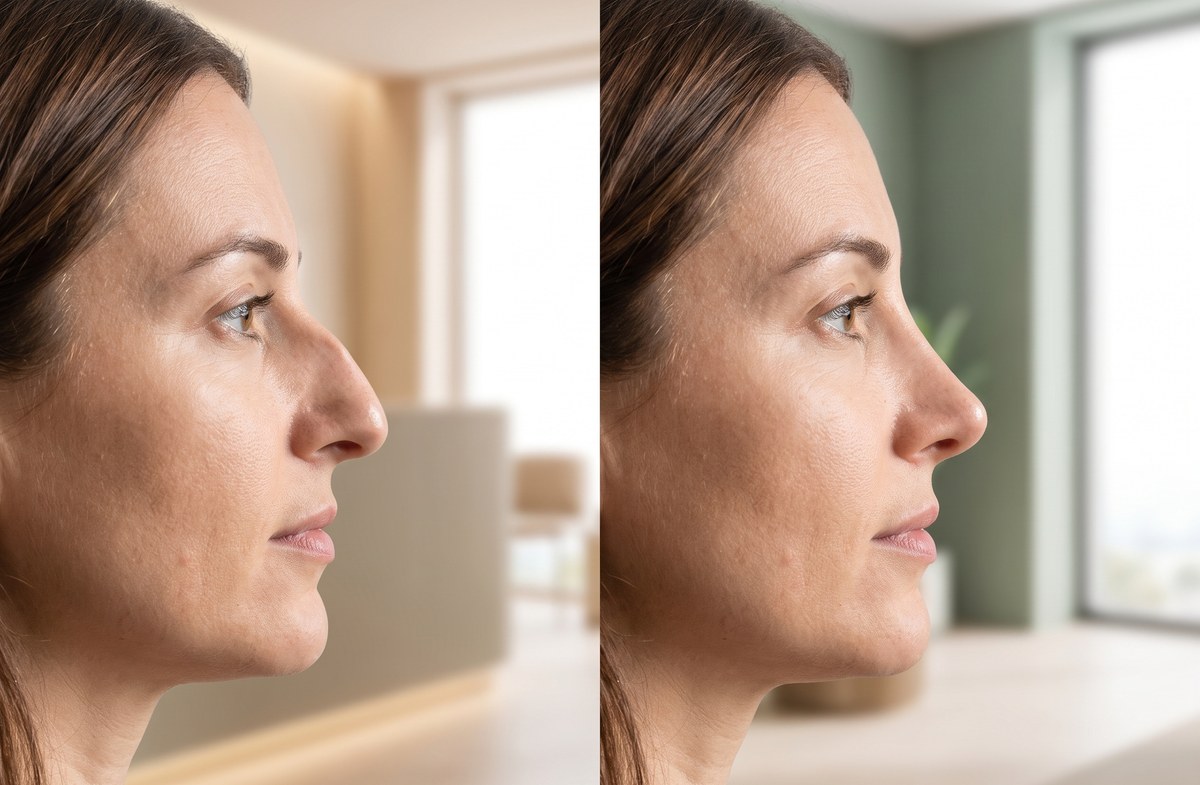
The method is decided on the image, not in words.
Our 3D simulation shows your future nose not only in profile but also from the front and from below. You therefore see your possible result from exactly the angles from which others see you every day — and before the operation we talk about the same image.
For the choice of method this is decisive. Whether a nose bridge is lowered in a preserving manner or structurally rebuilt, whether the tip is to be raised or only narrowed, whether the alar base has to be corrected as well — these are decisions that can be discussed on the simulated image and not in words. We also show you options that we do not recommend, and say why.
The simulation is a planning aid and not a promise: how tissue heals always plays its own part in the result. But it does make sure that you and we are talking about the same goal.
The technique determines the time — not the schedule.
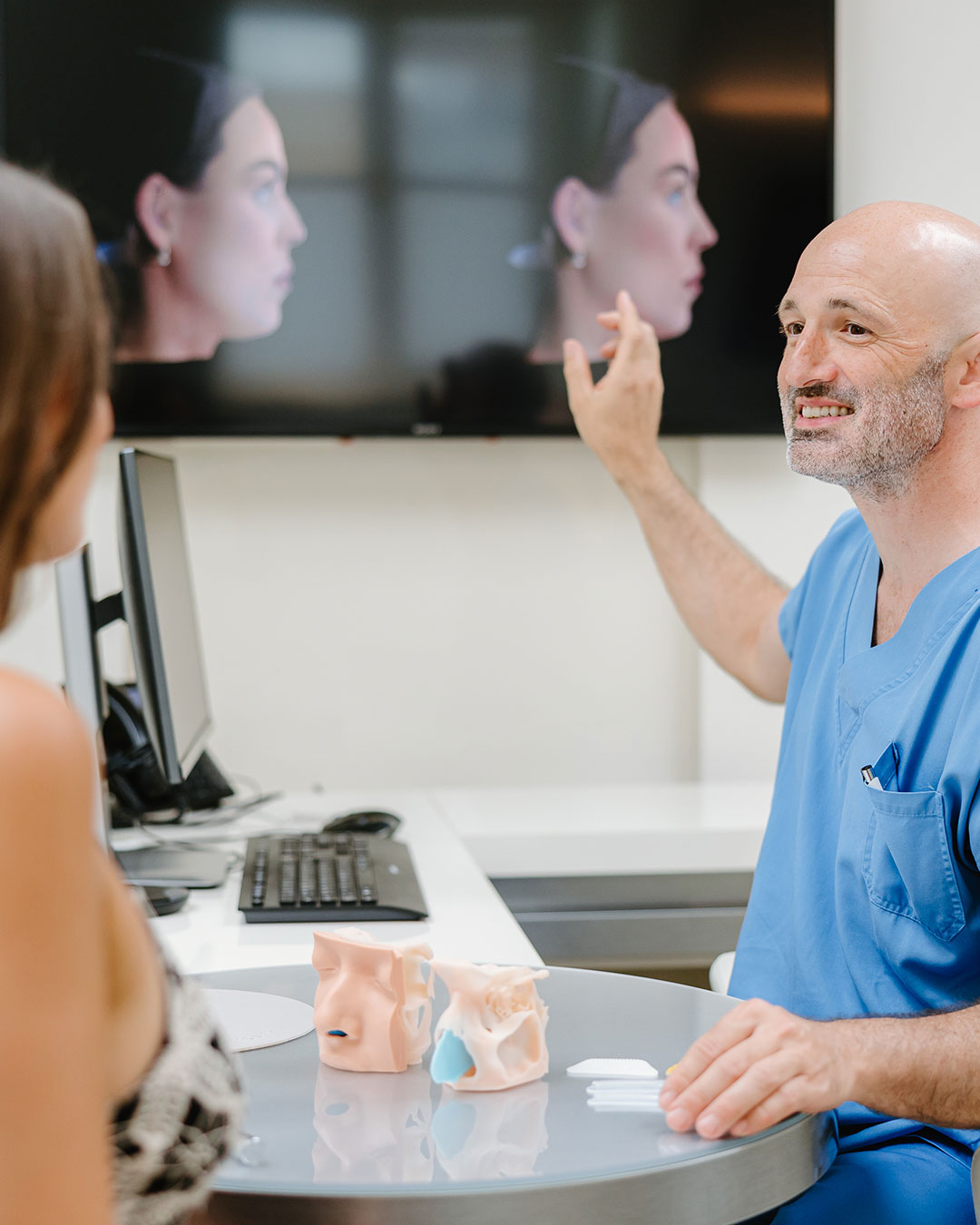
A rhinoplasty with us takes one to four hours. This range is intentional: we operate in our own operating theatres and therefore without time pressure — for as long as it takes until every detail is right. How long a procedure takes is decided by the findings, not by the schedule.
The choice of method has a direct effect on the duration. A limited correction via the closed approach lies at the lower end of the range. A cartilage-supported stabilisation of the tip with several grafts, a straightening with spreader grafts or a revision rhinoplasty with cartilage harvested from the rib area lies at the upper end. The more demanding technique is not the more expensive version of the same thing — it is the technique that these particular findings require.
Three surgeons, the entire spectrum of methods
Univ. Doz. Dr Rafic Kuzbari, Dr Christoph Grill and DDr. Jessica Wittmann have mastered every technique in modern nasal surgery.
-
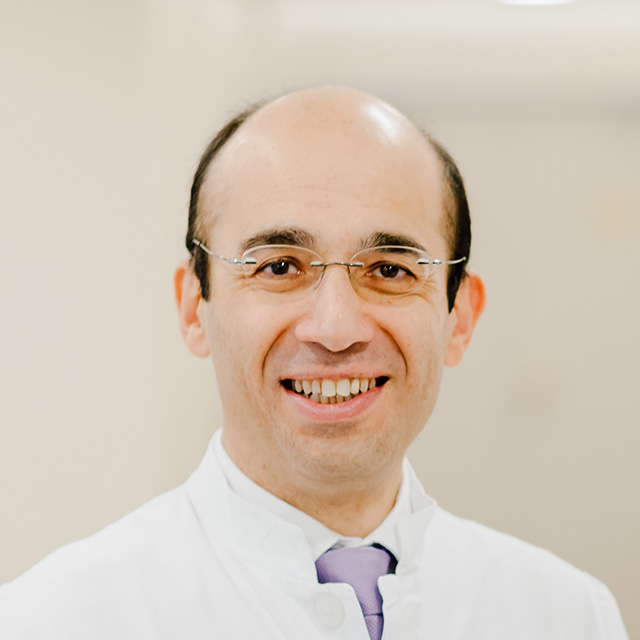
Univ. Doz. Dr Rafic Kuzbari
Specialist in Plastic, Aesthetic and Reconstructive Surgery
Over 30 years of experience; internationally regarded as an expert in revision procedures and complex rhinoplasty.
-
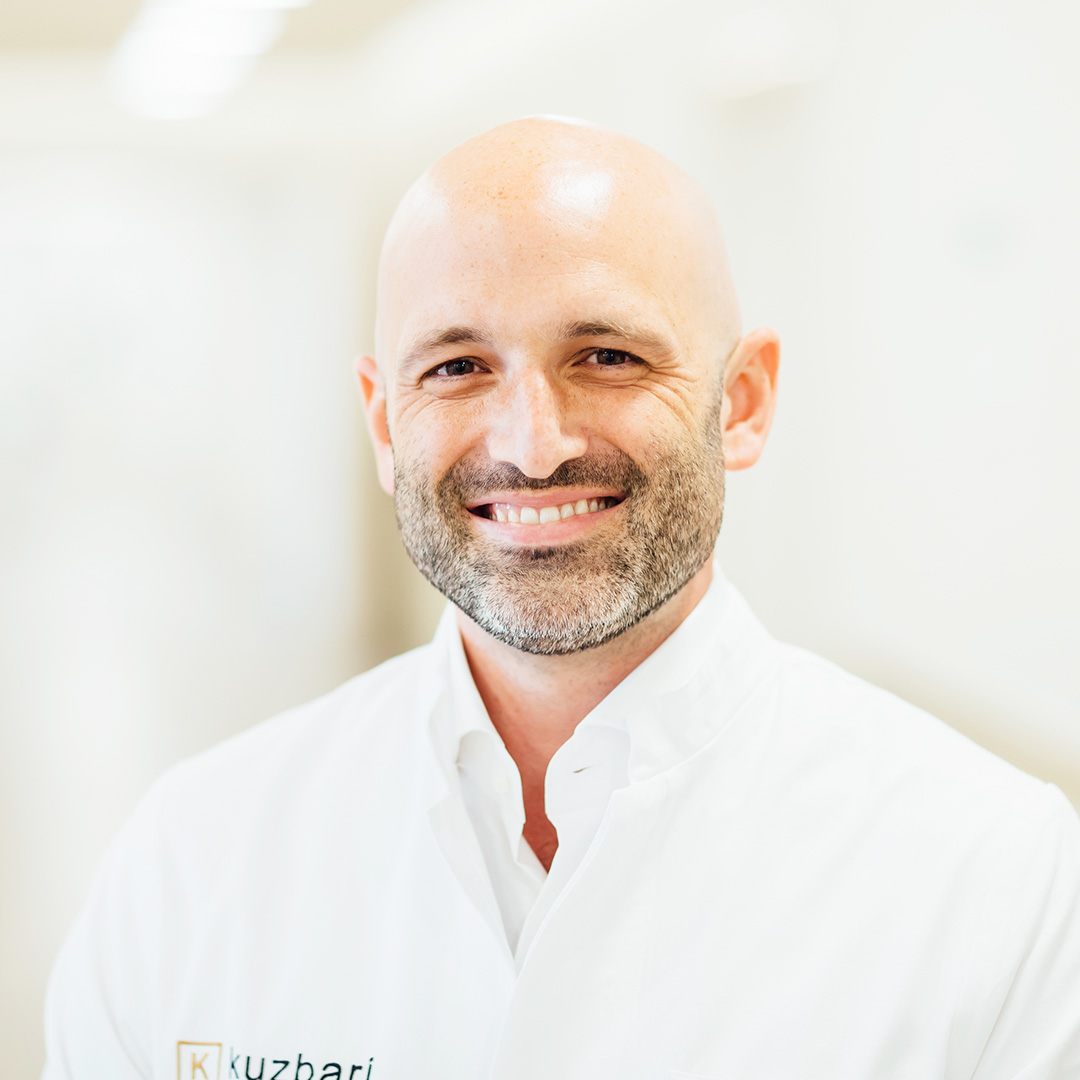
Dr Christoph Grill
Specialist in Plastic, Aesthetic and Reconstructive Surgery
A specialist in aesthetic and functional rhinoplasty with a focus on natural results.
-

DDr. Jessica Wittmann
Specialist in Oral and Maxillofacial Surgery
Combines the surgical and the aesthetic eye: precise nasal surgery with a sense for harmonious proportions.
Answers about the surgical methods
Open or closed — which method is better?
Neither technique is fundamentally superior. The closed method works from the inside without a scar; the open method offers more visibility with complex corrections. Which route is right for you we decide individually, based on your anatomy and your goal.
Are there visible scars with the open technique?
Access is through a fine incision on the columella. As a rule the scar is very small and barely visible once healed.
What is grafted in a rhinoplasty?
For augmentation and stabilisation we prefer to use the body's own cartilage — from the nasal septum, the ear or the rib area. The body's own tissue is well accepted and stable in the long term.
Can I choose the method myself?
We advise you in detail and recommend the approach that is optimal for you — and we make the decision together. The 3D simulation helps to make sure you and we have the same picture in mind.
What is a piezotome?
A piezotome is an ultrasound instrument for working on bone without injuring the soft tissue, the mucous membrane or the blood vessels; classically this is done with a chisel and a saw. It means more precise work on the bone and, as a rule, fewer bruises and less swelling. The piezotome is not a method of rhinoplasty in its own right — it is a tool for one step of the procedure, and the planning and the experience of the surgeon remain decisive. We use it as standard in every nasal operation; Univ.-Doz. Dr Rafic Kuzbari has been doing so for years.
Are several methods combined as well?
Yes. Often it is only the combination of several techniques — reduction at the nose bridge together with build-up at the nasal tip, for instance, or form and function in a single procedure — that leads to the most harmonious result. The hybrid technique itself concerns the nasal bridge alone: part of the bridge is preserved while other structures are modified in a targeted way. That keeps the advantages of dorsal preservation while widening the range of cases it can be used for.
What is the nose-bridge-preserving technique (dorsal preservation)?
With dorsal preservation (the nose-bridge-preserving technique) the natural nose bridge is retained instead of being removed and rebuilt. The height is reduced further down — at the nasal septum and below the nasal root — so that the bridge is lowered as a unit that has grown together. The result looks particularly natural, it is stable in the long term, and the risk of later irregularities on the nose bridge is reduced, which counts above all with thin skin. Certain forms of crookedness also recur less often. We work a great deal with this technique and with hybrid techniques, not exclusively with the traditional structural septorhinoplasty.
Is dorsal preservation suitable for every nose?
No — and we say so deliberately. For many findings it is the gentler choice, but it is not generally superior. If the nasal septum is severely deformed, if material is missing after previous operations, or if the nose bridge is to be raised rather than lowered, a structural build-up is the better solution. The decision is made at your examination.
What does “cartilage-supported” mean at the nasal tip?
The nasal tip is carried by cartilage alone. Cartilage-supported means that we do not merely shape it but actively support it — with a strut at the columella, for example, with an extension of the nasal septum forwards or with a reinforcement of the alar cartilages, all from your own cartilage. This considerably reduces the risk of drooping of the nasal tip over the years.
Why your own cartilage and not foreign material?
Your own cartilage is accepted as your own tissue, integrates and is stable in the long term. That is why it is our first choice for building up and stabilising. We use custom-made implants only in selected reconstructive situations, and we then discuss this with you explicitly.
What are spreader grafts?
Narrow strips of cartilage that are placed between the nasal septum and the upper lateral cartilages. They hold the internal nasal valve open — the narrowest point of the entire airway — and at the same time stabilise the line of the middle third of the nose. They therefore improve breathing and form in one step.
Is the nasal septum operated on in every rhinoplasty?
Not in every one, but in a great many. On the one hand because a deviated nasal septum impairs breathing and pushes the external form outwards. On the other because it is the cartilage donor from which supporting elements are obtained. A load-bearing marginal strip is always left in place.
Does harvesting cartilage at the ear or at the rib leave traces?
At the ear the access lies in the natural fold behind or within the auricle; the shape and stability of the ear remain unchanged, and once healed the scar is practically invisible. In the rib area a small scar forms in the inframammary fold. We go through both of these with you in the informed-consent consultation before you decide.
Can a rhinoplasty be done without surgery?
Injections can even out small contours — visually filling in a dip on the nose bridge, for example. What they cannot do: reduce the nose, straighten it, raise the nasal tip permanently or improve breathing. perfekte-nase.at is about surgical rhinoplasty; whether an operation is needed in your case at all is something we will tell you honestly at the consultation.
How is the method documented?
Your starting situation is documented photographically and with the 3D scan, the planned technique is set out in your informed-consent consultation, and what was actually carried out in the operation report. At the follow-up appointments we continue to photograph the course — so the result can be traced over months.
Does a more demanding method take longer in the operating theatre?
Yes. A rhinoplasty with us takes one to four hours; a cartilage-supported stabilisation of the tip with several grafts or a revision rhinoplasty with cartilage harvesting lies at the upper end of this range. Because the operating theatres are our own, we operate without time pressure — the duration follows the findings.
The reason why the result is meant to last.
An initial consultation with three-dimensional simulation, a technique that suits your nose, and an operating time that follows the findings — this effort is the reason why rhinoplasty with us has its price. It is also the reason why the result is meant to hold: for a lifetime, not for a few years.
Rhinoplasty, 27
The patient does not want a “perfect”, “mini snub nose”, but a nose that suits her face well. The nose should not look operated on. Among other things she is bothered by the drooping nasal tip and the crooked nose. With the operation the patient also wants an improvement in her restricted nasal breathing on the left.
Operation performed: Open nose surgery (open septorhinoplasty).


Book your rhinoplasty consultation now
Our rhinoplasty specialists
Univ. Doz. Dr Rafic Kuzbari
Specialist in Plastic, Aesthetic and Reconstructive Surgery
Dr Christoph Grill
Specialist in Plastic, Aesthetic and Reconstructive Surgery
DDr. Jessica Wittmann
Specialist in Oral and Maxillofacial Surgery