Nasal tip correction.
Does your nasal tip bother you? Perhaps it looks too broad, too bulbous, too droopy or simply out of keeping with your features. A targeted nasal tip correction can change that — with subtle changes that underline your natural beauty.

The nasal tip is a central element of your face.
A nasal tip that is too broad, droopy or asymmetrical can disturb the harmony of your features. Often a hump, a deviation of the nose or other aspects should or can be taken into account and corrected alongside a nasal tip correction, in order to achieve a harmonious result. In some cases, though, a targeted correction of the nasal tip alone is enough to improve your appearance considerably.
At the Kuzbari Centre we rely on subtle changes that bring out your natural beauty.
The nasal tip is supported by cartilage alone.
The lower third of the nose contains no bone. What supports the nasal tip are two paired alar cartilages, which brace against one another like two curved bands, and the front edge of the nasal septum, which holds them from below. Between them lie connective tissue, small muscles and the skin — at the tip, incidentally, the thickest skin of the entire nose, with the most sebaceous glands.
Three measures describe how a nasal tip sits within the face. Projection is the question of how far the tip protrudes from the face. Rotation describes how far it points upwards or downwards — measurable by the angle between the nose and the upper lip, which in women often appears somewhat more open than in men. Definition means how clearly the tip is recognisable as a shape: whether it shows two fine highlights or appears as a round, undifferentiated dome.
Almost every concern patients describe about the nasal tip can be traced back to one of these three measures — and to the skin above them. “Bulbous” usually means too little definition with strong alar cartilages and thick skin. “Drooping” means too little rotation, often combined with weak support from below. “Too pointed” means too much projection with narrow cartilages and thin skin that shows every edge.
Because all three measures depend on the same cartilage construction, one never changes just one of them. Raising the tip also reduces its perceived length. Narrowing it makes it appear to protrude further. It is precisely this interplay that makes the nasal tip one of the most demanding areas in all of nasal surgery — and why millimetres really do count here.
What patients come to us with
Each of these starting points calls for a different technique. Which of them applies in your case is something we clarify during the examination and with the 3D simulation.
-
Wide, undefined tip
Strong alar cartilages set wide apart, often with thick skin above them. The tip appears round and without contour. We realign the cartilages with fine sutures rather than removing substance — with thick skin this is frequently supplemented by a thin onlay graft that gives the tip definition.
-
Drooping tip
The tip points downwards, the angle to the upper lip is too closed, and smiling accentuates the effect. The cause is usually support from below that is too weak. We raise the tip forwards by means of an extension of the nasal septum and brace it with cartilage support — not by shortening.
-
Tip that protrudes too far
The nose projects far out of the face and appears dominant in profile. The projection is reduced in a targeted way, without flattening the tip. Afterwards the support needs particular attention, so that the tip remains stable in its new position.
-
Asymmetrical tip
The two halves of the tip are shaped differently or sit at different heights — congenitally, after an accident or after previous surgery. We balance the alar cartilages against one another and add material where substance is missing. Perfect symmetry does not exist in any face; pronounced asymmetries can be reduced considerably.
-
Arched profile
A hump and a drooping tip often occur together and visually reinforce one another. A correction confined to the tip would stop halfway here — usually the nose bridge is treated as well, so that the profile line is right as a whole.
-
Tip after previous surgery
Tips that have been raised too far, are retracted or irregularly shaped after a first procedure. The tissue is scarred and cartilage is often missing. We deliberately take on such cases — they call for more augmentation than reduction and a more stable construction than a first operation.
Nasal tip correction at a glance
| The aim of the operation | Refining, lifting or reshaping the nasal tip for a harmonious face |
|---|---|
| Duration of surgery | 1 – 4 hours |
| Fit for work | After 3 – 7 days |
| Presentable again | After 1 – 3 weeks |
| Recovery, sport | 4 – 6 weeks |
| Final result | 6 – 12 months with thick skin up to 18 months |
| Specialists | Dr Grill, DDr. Wittmann |
How thick is your skin?
Why the thickness of your skin is decisive for the result of your nose surgery — and how it is assessed.

Rhinoplasty — from the first consultation to the aftercare
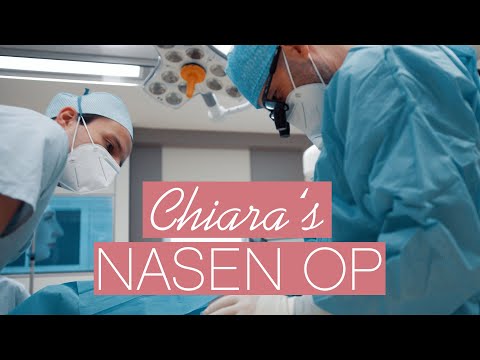
Stabilising with cartilage support — so that the tip stays up.
We stabilise the nasal tip using modern cartilage-supported techniques. This considerably reduces the risk of the tip drooping again over the years.
That sentence is the core of this page, so here is the reasoning behind it. There are two ways of changing a nasal tip. The first takes substance away: cartilage is narrowed, shortened, partly removed — the tip becomes smaller and more delicate. In the short term this looks good. In the long term the construction lacks the structural support that carried it; scar contraction and gravity pull for years on a framework that has become thinner. The tip rotates downwards, the nose looks longer again, the profile arched again.
The second way shapes and supports at the same time. Several elements are available for this, which we use individually or in combination depending on the findings:
A strut in the columella. A strip of cartilage is anchored upright between the two halves of the columella and carries the tip from below — the single most effective measure against late drooping.
An extension of the nasal septum forwards. A cartilage element at the front edge of the nasal septum determines how far forward and at what angle the tip sits. This is how we raise a drooping tip without shortening the nose — and how we set the position it is meant to hold permanently.
Suture techniques on the alar cartilages. Very fine sutures realign the cartilages to one another. This makes the tip narrower, clearer and more symmetrical — without any loss of substance. Shaping rather than removing is gentler on the tissue and more stable in the long term.
Reinforcement of the alar cartilages. Thin strips of cartilage that give firmness to weak or inwardly curved alar cartilages. At the same time they hold the nostrils open, which can otherwise collapse on inhalation.
An onlay graft on the tip. A thin disc of cartilage that strengthens projection and definition. Often necessary with thick skin, because otherwise the skin swallows every piece of fine work beneath it. Its edges are deliberately trimmed soft, so that nothing shows through later.
The cartilage for this preferably comes from the nasal septum, because it lies within the surgical field and is straight. For the curved parts of the tip, ear (conchal) cartilage is particularly suitable, because it naturally has the right curvature. In revision rhinoplasty, when the nasal septum is no longer available as a source, cartilage from the rib area is an option.
This work cannot be seen from the outside and it costs operating time. It is the reason why a nasal tip should still be standing ten years later where it stood after the operation.
Why your skin has a say in the result.
At the nasal tip, the skin determines how much of the work beneath it becomes visible at all. This is the most common reason why two patients who have had an identical operation end up with tips that look different.
Thin skin shows the framework very directly. Definition arises here almost by itself — but every edge, every cartilage margin and every irregularity also shows through. We therefore work with particular restraint, round off all transitions and pad them with fine soft tissue where needed. That we frequently take a nose-bridge-preserving approach at the nose bridge has the same background: where no surface is newly joined, no edge can show through later either.
Thick skin forgives fine detail, but it also swallows it. Here the structure beneath has to be set deliberately more clearly and more strongly, otherwise the tip stays round. Thick skin also takes longer to settle onto the new shape: the final result can take up to around 18 months here. We say so beforehand — not when the disappointment arrives in the sixth month.
We assess your skin thickness during the examination and raise it explicitly in the consultation, because it determines both the achievable result and the time it takes.
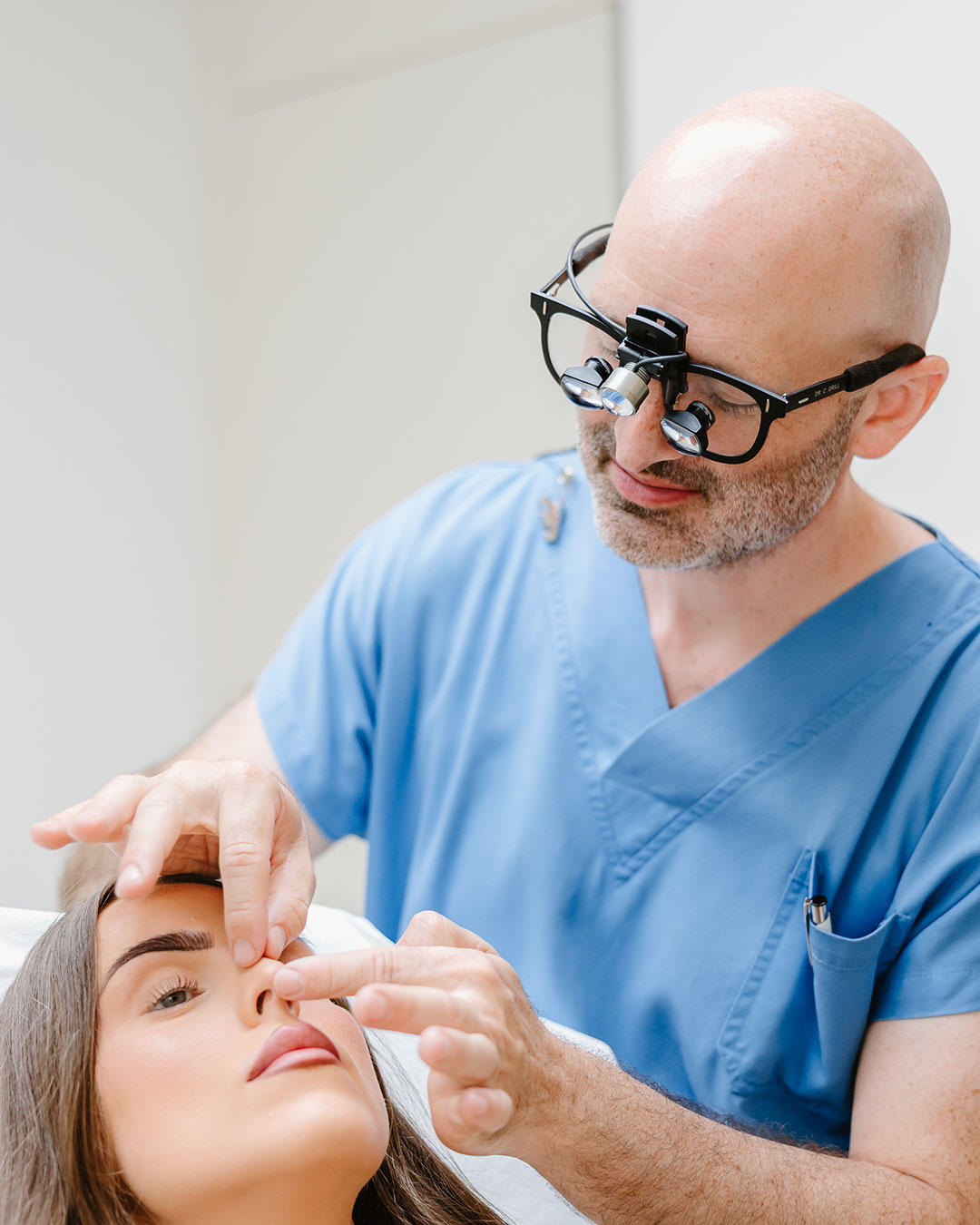
The tip is judged from below.
Our 3D simulation shows your future nose not only in profile, but also from the front and from below. So you see your possible result from exactly the angles from which others see you every day — and before the operation we are talking about the same image.
With the nasal tip this matters particularly. Rotation and projection can be assessed well in profile — definition and symmetry of the tip, by contrast, hardly at all. Both only become apparent in the frontal view and in the basal view: that is where it becomes visible whether the tip carries two clear highlights, whether the nostrils are symmetrical and whether the columella sits straight.
We model this image together with you — and we also show you variants we would advise against. A strongly raised tip, for instance, often looks attractive in a photograph and quickly looks done in a moving face. The simulation is a planning aid, not a promise: the healing of the tissue always plays its own part in the result.
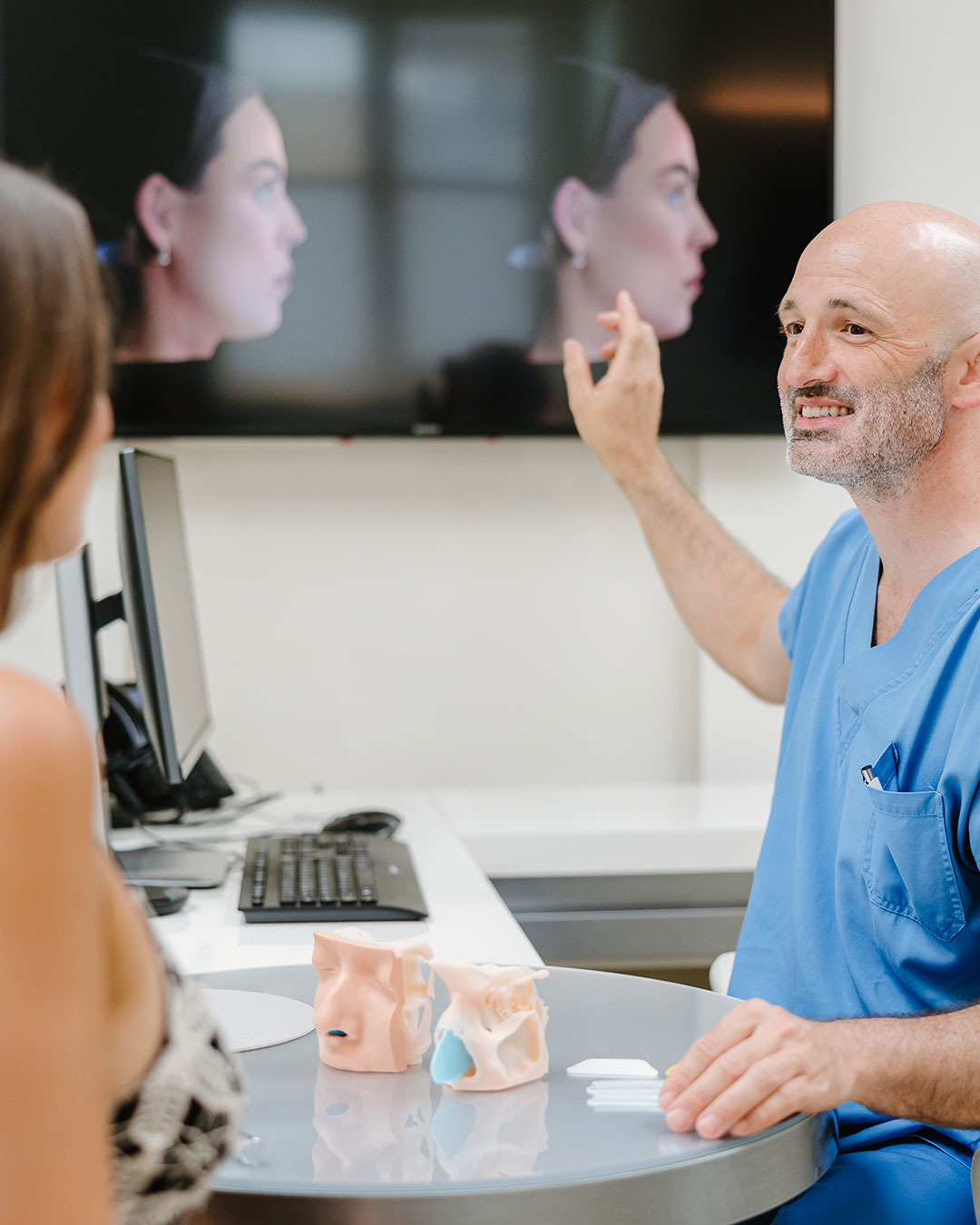
Specialisation. Safety. Experience.
There is hardly a clinic in Austria in which more operations in the field of aesthetic nasal surgery are carried out each year. At the Kuzbari Centre no fewer than three specialists devote themselves to facial surgery: Univ. Doz. Dr Rafic Kuzbari, Dr Christoph Grill and DDr. Jessica Wittmann.
From the first consultation with 3D simulation, through the operation in our own high-tech operating theatres, to the aftercare — everything under one roof, so that your nasal tip correction goes safely, precisely and as comfortably as possible.
The highest possible safety. We have three of the most modern operating theatres in Austria. Our team specialises exclusively in aesthetic medicine. As a clinic we are inspected several times a year by independent bodies. All the materials and implants we use are selected on the basis of scientific studies.
Your nasal tip correction step by step
-
01
The first consultation
Getting to know each other personally, a detailed analysis of your features and nasal anatomy, a 3D simulation with Vectra technology, before-and-after comparisons and a thorough explanation of the process. We never push you towards an operation.
-
02
Preparation
Medical examinations, an anaesthetic consultation, individual surgical planning based on the 3D simulation, clear instructions for preparation.
-
03
The operation
Personal care before surgery, a procedure of 1 – 4 hours in one of our modern operating theatres using advanced techniques such as cartilage modelling or special suturing methods.
-
04
Aftercare & healing
The recovery room, a thorough follow-up conversation the next morning, discharge with your surgeon's emergency number, regular check-ups until the final result after 6 – 12 months.
Why is cartilage grafted?
Univ. Doz. Dr Rafic Kuzbari explains why cartilage is grafted in rhinoplasty and how it stabilises the shape in the long term.

What you receive with us
-
Natural results
We create a nasal tip that complements your features harmoniously without looking artificial.
-
Experienced specialists
Three specialists focused exclusively on facial surgery: Univ. Doz. Dr Kuzbari, Dr Grill and DDr. Wittmann.
-
State-of-the-art technology
Vectra 3D simulation and our own high-tech operating theatres.
-
Everything under one roof
Consultation, operation and aftercare — all in one place.
-
Maximum safety
The strictest hygiene standards, scientifically selected materials, quality-assured processes.
-
Recognised quality
Multiple DocFinder Patients' Choice Awards.
A nasal tip that looks natural.
The nasal tip determines the overall impression of the nose — and it is often millimetres that make the difference. The goal is never a “made” tip, but one that looks so self-evident it might always have been that way.
When the proportions are right, the nose recedes into the background — and your eyes come to the fore.
Why we take so much time over the tip.
A rhinoplasty takes us one to four hours. That range is deliberate: we operate in our own operating theatres and therefore without time pressure — for as long as it takes until every detail is right. How long a procedure takes is decided by the findings, not by the schedule.
At the nasal tip this principle shows most clearly. The section in which strut, extension, sutures and onlay grafts are placed is the most intricate of the whole operation. Each piece of cartilage is trimmed, fitted and fixed, then the tip is assessed from several angles — and frequently it is released and set again, because a millimetre is missing. These repetitions are not hesitation, they are the work.
That we can afford them is down to the fact that the operating theatres belong to us. Nobody is waiting for the room. The last half hour at a nasal tip often decides more about the result than the first hour of the operation.
Why the tip in particular takes the longest
The nasal tip is the area with the thickest skin and the slowest lymphatic drainage. It is therefore the part of the nose that shows its final appearance latest.
-
First week
The tip is markedly swollen, the splint protects the new shape, sensation in the skin is reduced. What you see at this stage says nothing yet about the result. After about a week we remove the splint and the sutures.
-
Weeks 2 to 4
The tip often still appears raised and wider than planned — both are swelling and entirely normal. The bruising has gone and you are presentable in public. The skin over the tip feels numb and stiff.
-
Month 2 to 3
The contours begin to emerge and the highlights at the tip become visible. Sensation slowly returns, sometimes with a brief tingling — a good sign. The angle to the upper lip settles slightly into its final position.
-
Month 4 to 6
The tip becomes more defined and narrower, because the residual swelling in the soft tissue subsides. With thin skin the result is often already very close to its final state by now.
-
Month 6 to 12
The final result becomes apparent. The skin has settled onto the new framework, the shape is stable, sensation has returned. The difference from the sixth month is usually small, but decisive for the refinement of the tip.
-
Up to month 18
With thick skin and after revision rhinoplasty, the final definition of the tip can take up to around 18 months. That is not a complication but the course this tissue needs — and we say so beforehand, so that nobody starts doubting themselves in the sixth month.
What is possible at a nasal tip — and what is not.
Readily possible: a tip that is more clearly defined. A drooping tip that is raised and stays raised. A pronounced asymmetry that is visibly reduced. A projection that suits the face. And a result that nobody recognises as operated on — that remains our benchmark.
There are limits, too. Perfect symmetry does not exist in any nose; the two halves of the tip remain different, even if less so than before. Thick skin cannot be made thinner — it determines how much definition is achievable. A very strongly raised tip is technically feasible, but in a moving face it often looks done; we advise against it. And scar tissue behaves individually: how soft tissue contracts over months can be planned, but not forced.
When a correction confined to the tip falls short: when a hump is present at the same time, when the nose as a whole looks too large for the face, or when there is a pronounced deviation. An isolated tip correction would then merely shift the disharmony. We tell you in the consultation if we advise a more extensive procedure — even when you came to us for a smaller one.
The nasal tip also determines how you breathe.
That a tip correction affects breathing surprises many people. The reason lies in the external nasal valve: the area in which the nostrils are held open by the alar cartilages. If these cartilages are naturally weak, curved inwards or have been weakened during previous surgery, the nostrils collapse on forceful inhalation. Those affected notice it above all during exercise and when lying down — and often help themselves unconsciously by pulling the nostril outwards with a finger.
We check this area at every examination, because shaping work at the tip inevitably affects it. If cartilage is removed without securing the opening, a beautiful tip can make breathing worse. If, on the other hand, the tip is supported with reinforcement of the alar cartilages, the same measure improves shape and breathing at once. That is precisely why we think of the two together and plan every tip correction from the function upwards.
When a nasal tip correction makes sense.
Age. For aesthetic indications we operate once facial growth is complete — in women usually from around the age of 16, in men somewhat later. There is no upper age limit: what matters is general health and tissue quality, not your year of birth. With older skin we work somewhat more conservatively, because the skin takes longer to settle onto a new framework.
Time of year. This matters less than is often assumed. What does matter: in the first few weeks the nose should be protected from strong sunlight, and contact sport is off the table for some time. Many patients therefore schedule the procedure for a period when their diary is quieter anyway — semester holidays, a longer break, a less demanding stretch at work.
Circumstances. Allow two to three weeks during which you do not have to be in the public eye, and expect the nose to show its final shape only after several months. If you are working towards a fixed date — a wedding, an examination, a photo shoot — allow generous time: at least six months, and with thicker skin closer to twelve.
And one point that matters to us. A nasal tip correction is a good decision when it comes from your own, settled wish. In a stressful phase of life, in the wake of a separation, or under pressure from those around you, we advise postponing the procedure. The consultation about it is without obligation — it commits you to nothing.
Your nasal tip correction from start to finish
Before the operation
- Initial consultation of around an hour, without obligation
- Vectra 3D simulation from the profile, frontal and basal view
- Examination of skin thickness, cartilage strength and breathing function
- Photographic documentation of your starting situation
- Written cost estimate
- Informed-consent consultation and pre-anaesthetic assessment
On the day of the operation
- Our own operating theatre at the Kuzbari Centre
- One to four hours — according to the findings, not to a plan
- Cartilage-supported stabilisation of the nasal tip
- Piezotome whenever work is done on the bone
- One night as an inpatient with round-the-clock care
After the operation
- A follow-up talk on the morning after the operation
- The mobile number of your surgeon
- Removal of splint and sutures after about a week
- All follow-up appointments up to the final result included
- Continued care beyond the twelfth month as well
„At the nasal tip, millimetres decide — and so does the question of whether in ten years it is still where we put it.“
Rhinoplasty, 20
The patient is affected by the shape of her nose, above all the drooping nasal tip and the arched nasal profile.
Operation performed: Nose surgery


For your consultation
Questions specifically about the nasal tip
- What is it in my case — projection, rotation or definition?
- How will my tip be supported so that it does not droop again?
- Is cartilage removed or realigned?
- Where does the cartilage needed for the support come from?
- How thick is my skin — and what does that mean for the definition?
- When can I expect the final result, and when only an interim state?
- What does the tip look like from below and from the front, not just in profile?
- Does the nose bridge need to be treated as well in my case?
- Do the nostrils stay open on inhalation?
- How will the correction change my smile?
What is often corrected together
The nasal tip rarely stands on its own. These pages take further the topics that usually come up in the consultation at the same time.
-
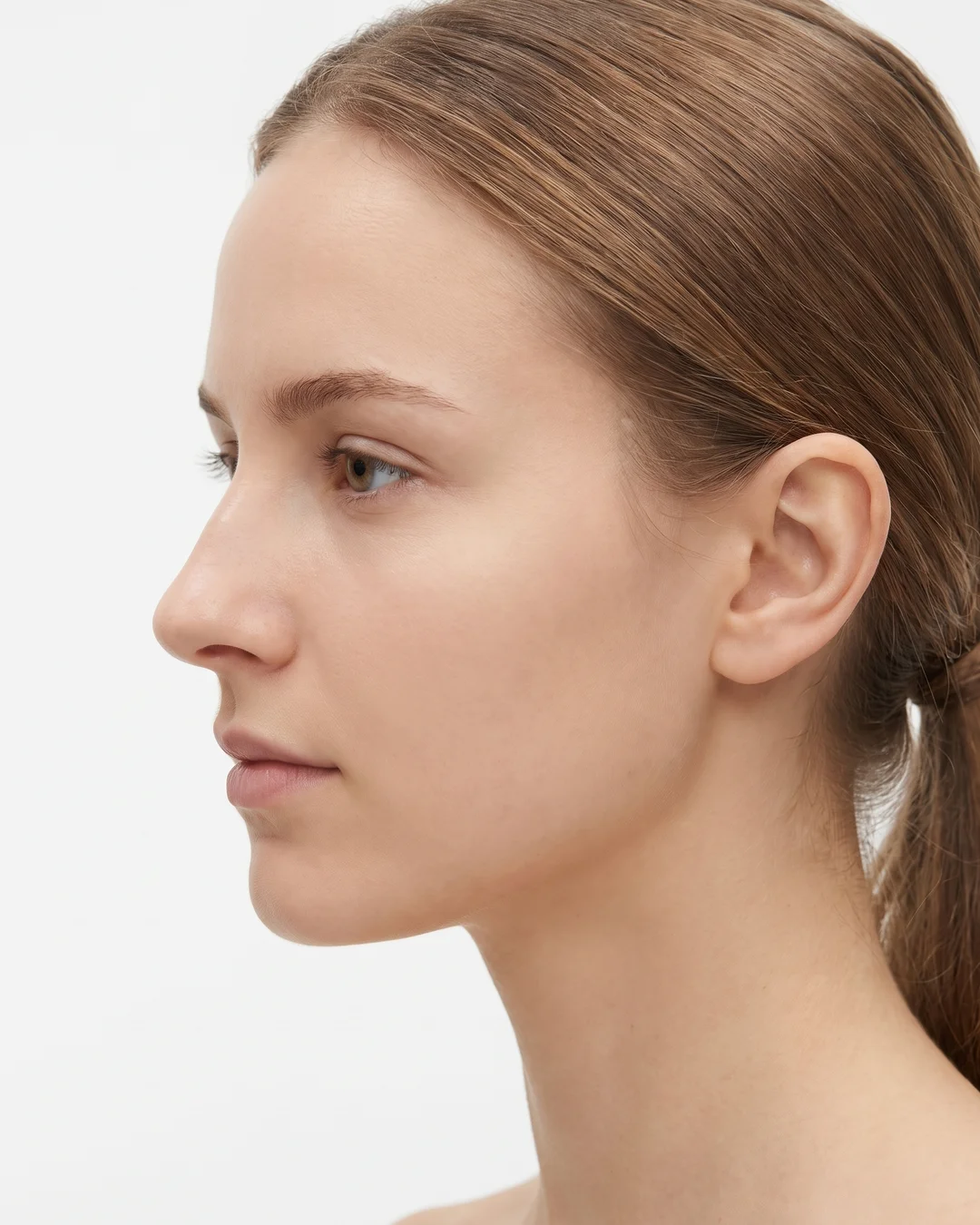
Nasal hump correction
A hump and a drooping tip often occur together and visually reinforce one another.
Learn more → -
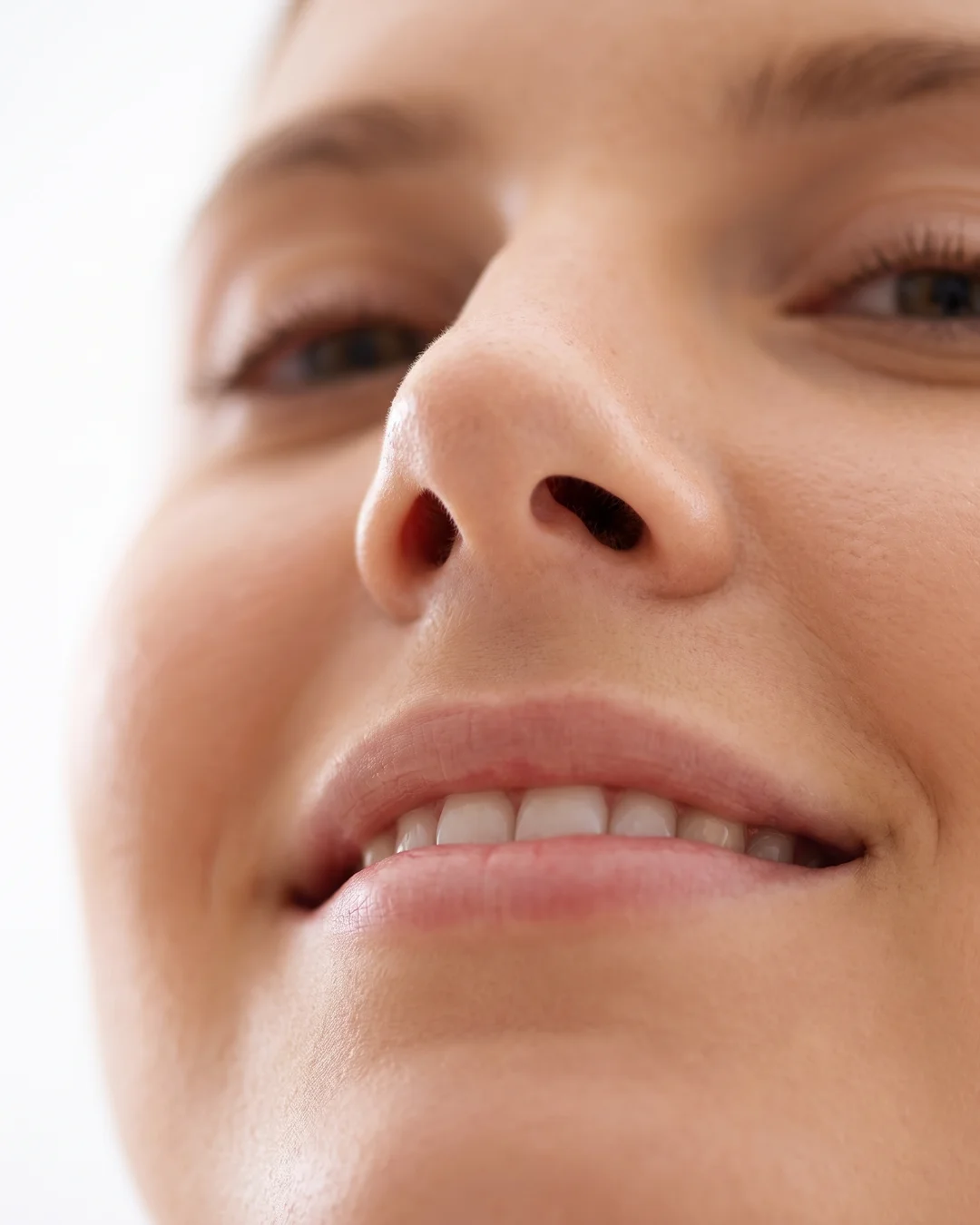
Nostril correction
If the tip is raised, the alar base appears visually wider — often the final refinement.
Learn more → -
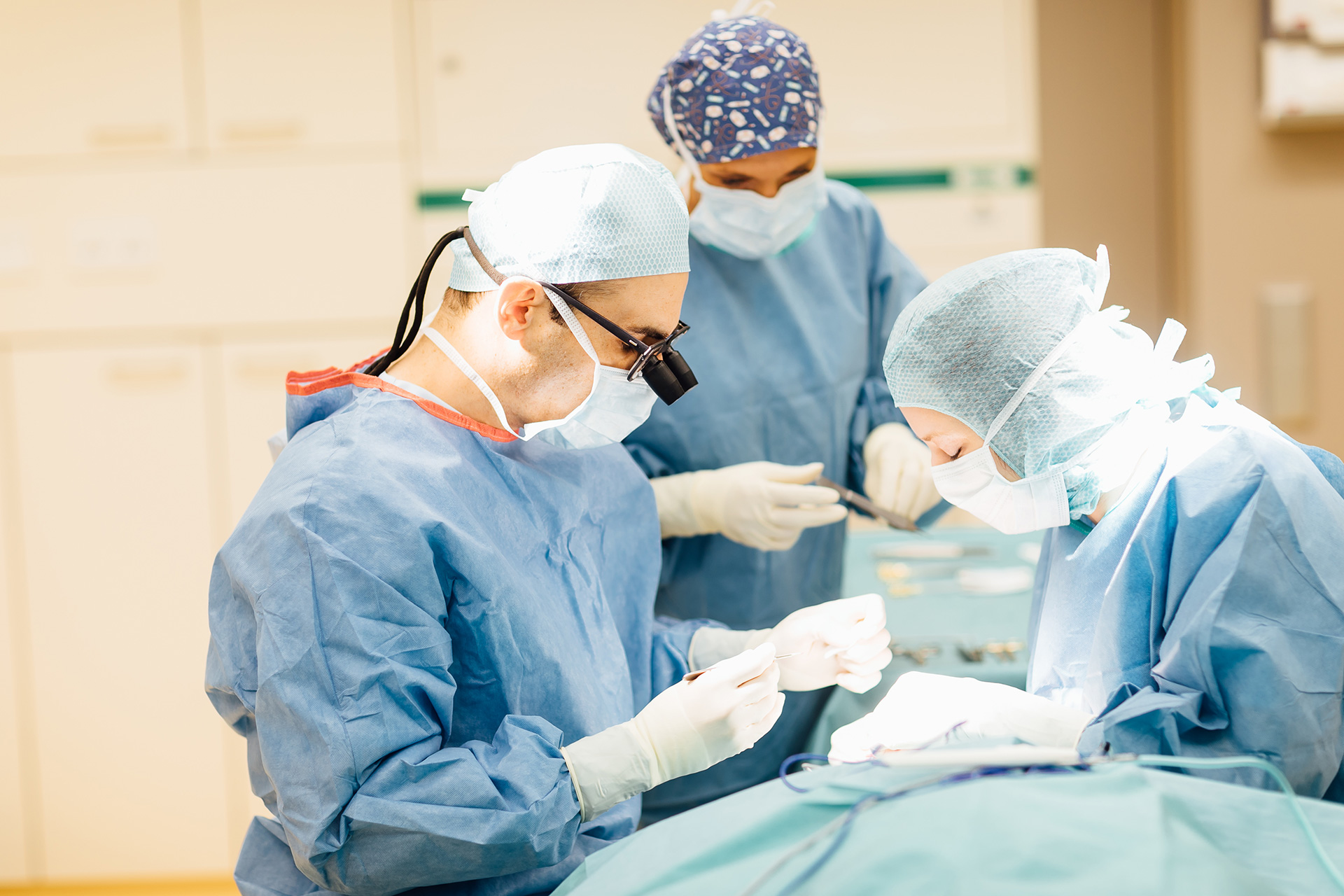
Surgical methods
All techniques at a glance — nose-bridge-preserving, structural, hybrid, open and closed.
Learn more →
Three surgeons for your nasal tip correction
-
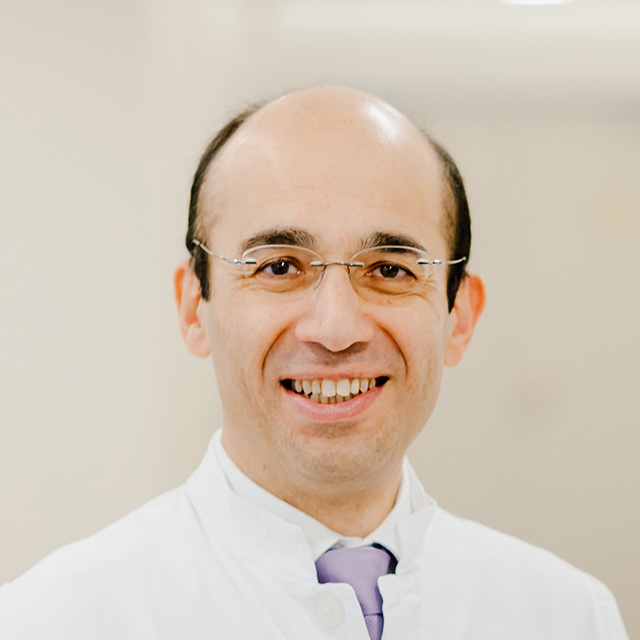
Univ. Doz. Dr Rafic Kuzbari
Specialist in Plastic, Aesthetic and Reconstructive Surgery
Over 30 years of experience; internationally regarded as an expert in revision procedures and complex rhinoplasty.
-
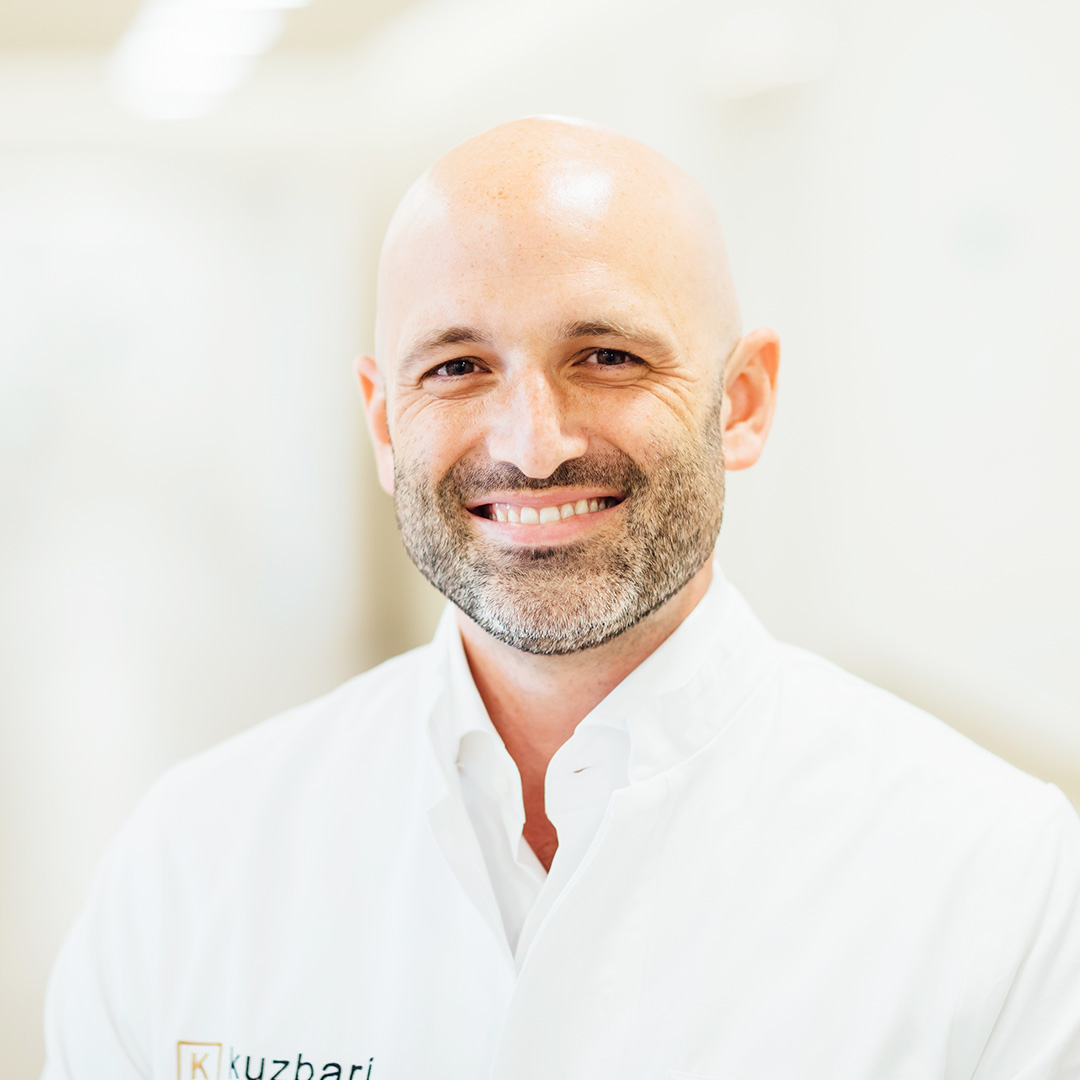
Dr Christoph Grill
Specialist in Plastic, Aesthetic and Reconstructive Surgery
A specialist in aesthetic and functional rhinoplasty with a focus on natural results.
-

DDr. Jessica Wittmann
Specialist in Oral and Maxillofacial Surgery
Combines the surgical and the aesthetic eye: precise nasal surgery with a sense for harmonious proportions.


Answers about nasal tip correction
Is a nasal tip correction painful?
During the operation you feel nothing thanks to the anaesthesia. After the procedure our patients usually report a slight feeling of pressure or a headache — both easily treated with painkillers.
How long does healing take?
You are fit for work after 3 – 7 days and presentable in company after 1 – 3 weeks; after 4 – 6 weeks you can take up sport and strenuous activities again. The final result is visible after 6 – 12 months.
Will there be scars?
With the open technique a small, barely visible scar on the columella is possible. In some cases we also use the closed technique, in which all the incisions are made inside the nose — with no visible scars.
Can breathing be affected?
Our specialists take care to preserve or improve the function of the nose. Where necessary a septum correction can be integrated to optimise the breathing. Breathing will be temporarily reduced after the operation by the swelling of the mucous membrane — that is part of the healing process.
How much does a nasal tip correction cost?
The cost depends on the extent of the procedure. At the first consultation you receive a transparent quotation.
Is the result permanent?
Yes, the results are permanent. Slight changes due to ageing processes are possible, but they barely affect the result. So that the tip holds its position, we stabilise it with cartilage-supported techniques — this considerably reduces the risk of it drooping again over the years.
Can the nasal tip droop again after the operation?
The nasal tip is supported by cartilage alone and is therefore the part of the nose that changes most over the years. If substance is removed without replacing the structural support, the tip can migrate downwards. That is precisely why we work with cartilage support: we do not only shape the tip, we brace it — with a strut in the columella, an extension of the nasal septum forwards or reinforcement of the alar cartilages.
What does a “bulbous” nasal tip mean medically?
Usually a combination of strong alar cartilages set wide apart and thick skin above them. The tip then has too little definition and looks round. We realign the cartilages with fine sutures instead of removing substance, and with thick skin we often add a thin cartilage onlay graft, so that the shape beneath the skin becomes visible at all.
How is a drooping nasal tip raised?
Not by shortening, but by support. A cartilage element at the front edge of the nasal septum determines how far forward and at what angle the tip sits, and a strut in the columella carries it from below. This preserves the length of the nose, and the new position is stable.
Is a nasal tip correction on its own enough, or does more need to be done?
That depends on the findings. Sometimes the procedure at the tip alone is enough for a clear improvement. Often, however, a hump, a deviation or the width of the nostrils should be corrected as well, because otherwise the disharmony is merely shifted. We tell you openly in the consultation — even when that means advising a more extensive procedure.
Will my smile change?
When you smile, a small muscle pulls the nasal tip slightly downwards; with a drooping tip this is particularly noticeable. After cartilage-supported stabilisation this movement is usually less pronounced, because the tip is better braced. The smile itself does not change.
How long is the nasal tip numb after the operation?
Reduced sensation in the skin of the nasal tip is the rule after the procedure and affects the fine skin nerves. In the first few weeks the tip is numb and stiff; over the following months sensation returns — often accompanied by brief tingling. After about a year it is usually normal again.
Do irregularities become visible at the nasal tip?
With thin skin the framework beneath shows through more directly — which is why we deliberately round off all edges, trim onlay grafts soft and pad transitions with fine soft tissue where needed. With thick skin the risk is lower, but the definition takes longer. We discuss both before the operation.
Is the cartilage taken from the ear or from the rib?
Preferably from the nasal septum, because it lies within the surgical field and is straight. For the curved parts of the tip, ear (conchal) cartilage is particularly suitable, because it naturally has the right curvature. Cartilage from the rib area is mainly an option in revision rhinoplasty, when the nasal septum is no longer available as a source.
Can a nasal tip also be corrected with injections?
Small contour irregularities can be visually evened out in this way. It cannot permanently raise, narrow or support a tip, and it does not improve breathing. If a non-surgical route would be sufficient in your case, we will tell you so in the consultation.
Can a previously operated nasal tip still be corrected?
Yes. Four in ten nose operations at the Kuzbari Centre are revision rhinoplasties on a nose that has already been operated on. These procedures require particular experience: the tissue is scarred, cartilage is sometimes missing, and the starting point is different for every patient. We deliberately take on such cases — at the tip that usually means more augmentation than reduction.
A result that is meant to last.
An initial consultation with three-dimensional simulation, a technique that suits your nose, and an operating time that follows the findings — this effort is the reason why rhinoplasty with us has its price. It is also the reason why the result is meant to hold: for a lifetime, not for a few years.
Book your rhinoplasty consultation now
Our rhinoplasty specialists
Univ. Doz. Dr Rafic Kuzbari
Specialist in Plastic, Aesthetic and Reconstructive Surgery
Dr Christoph Grill
Specialist in Plastic, Aesthetic and Reconstructive Surgery
DDr. Jessica Wittmann
Specialist in Oral and Maxillofacial Surgery